Freshwater and greywater days without silent default tanks
Estimate daily fresh use and grey inflow, then read autonomy from tank capacities you actually planned — empty projects have no hidden 80 L tank.
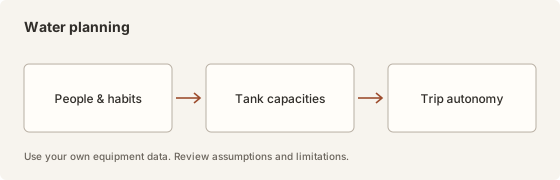
Planning workflow illustration. Confirm your own equipment data and review the result limitations.
Habits first, tanks second
Daily fresh demand combines drinking, cooking, washing, and shower litres. Grey inflow applies per-use drain fractions (drinking often contributes little grey; showers usually contribute most). Target days produce a recommended capacity — they never silently overwrite a tank specification you already linked.
Capacity vs contents
Tank capacity sets autonomy and full-tank water mass (~1 kg per litre for fresh water as a planning density). Planned contents are a separate fill scenario. Changing capacity does not auto-fill the tank; empty and full scenarios stay explicit.
Grey can limit the trip first
A trip can be limited by greywater storage even while fresh water remains. Review both tank durations and the limiting-resource label rather than looking only at fresh-water capacity.
Formula assumptions
Planning density for water mass ≈ 1 kg/L.
Fresh usable fraction accounts for unusable heel and sensor margins you choose.
Grey fractions are planning ratios per use category, not plumbing certifications.
Worked example
80 L fresh at 0.9 usable, 18 L/day
Enter the fresh tank’s nominal capacity and realistic usable fraction.
Enter the people and habits for the trip, then review fresh-water autonomy.
Enter the grey tank and drainage assumptions; check whether it limits the trip first.
This worked case uses explicitly chosen daily consumption and tank sizes. Open the water calculator or the Weekend couple example (80 L / 40 L).
Limitations
No assumption that grey equals every litre of fresh used, or that emptying one tank empties the other.
Potability, filtration, and blackwater systems are out of scope for the first water tool.
Freezing, expansion, and tank structural limits need product documentation.